 Mississauga heat risk
Mississauga, Ontario
Heat Risk in Mississauga
A multi-criteria GIS screening analysis for urban heat, social vulnerability, and mapped cooling support.
- Landsat LST
- Zonal stats
- Census ranking
Selected GIS Work
Mississauga heat risk
Mississauga, Ontario
A multi-criteria GIS screening analysis for urban heat, social vulnerability, and mapped cooling support.
 Interactive access map
Washington, D.C.
SNAP-supported access gaps become clearer when mapped against poverty.
 Environmental GIS / urban forestry
Windsor, Ontario
A planning-level suitability workflow for candidate planting priority areas.
 State-level rates and change
United States
Rates, change, and shelter status reveal different state-level patterns.
 Comparable-county ratio map
U.S. Counties
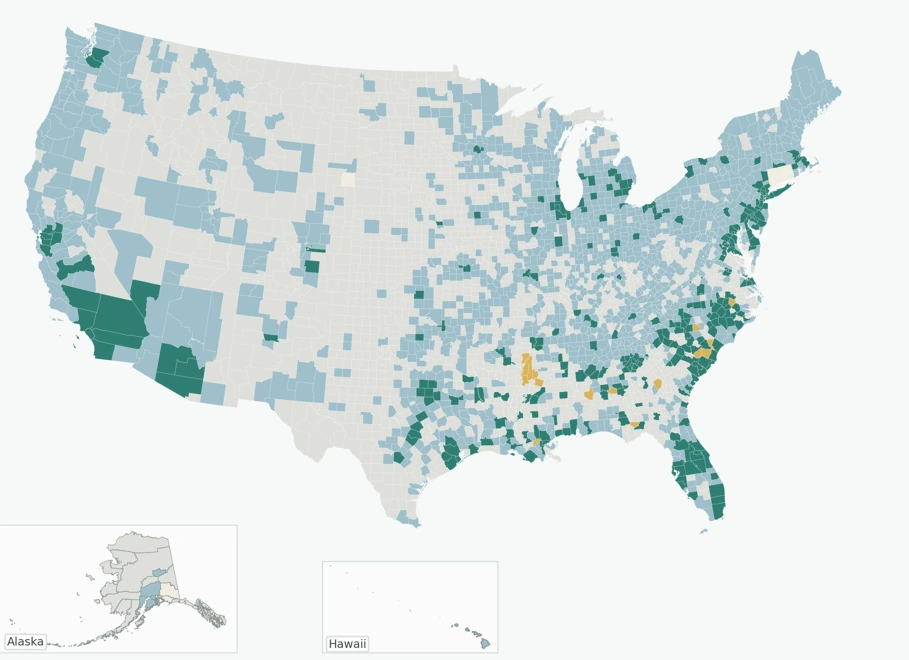
County-level ratios show visible disparities where comparison is possible.
Mississauga, Ontario | Climate resilience | Spatial analysis
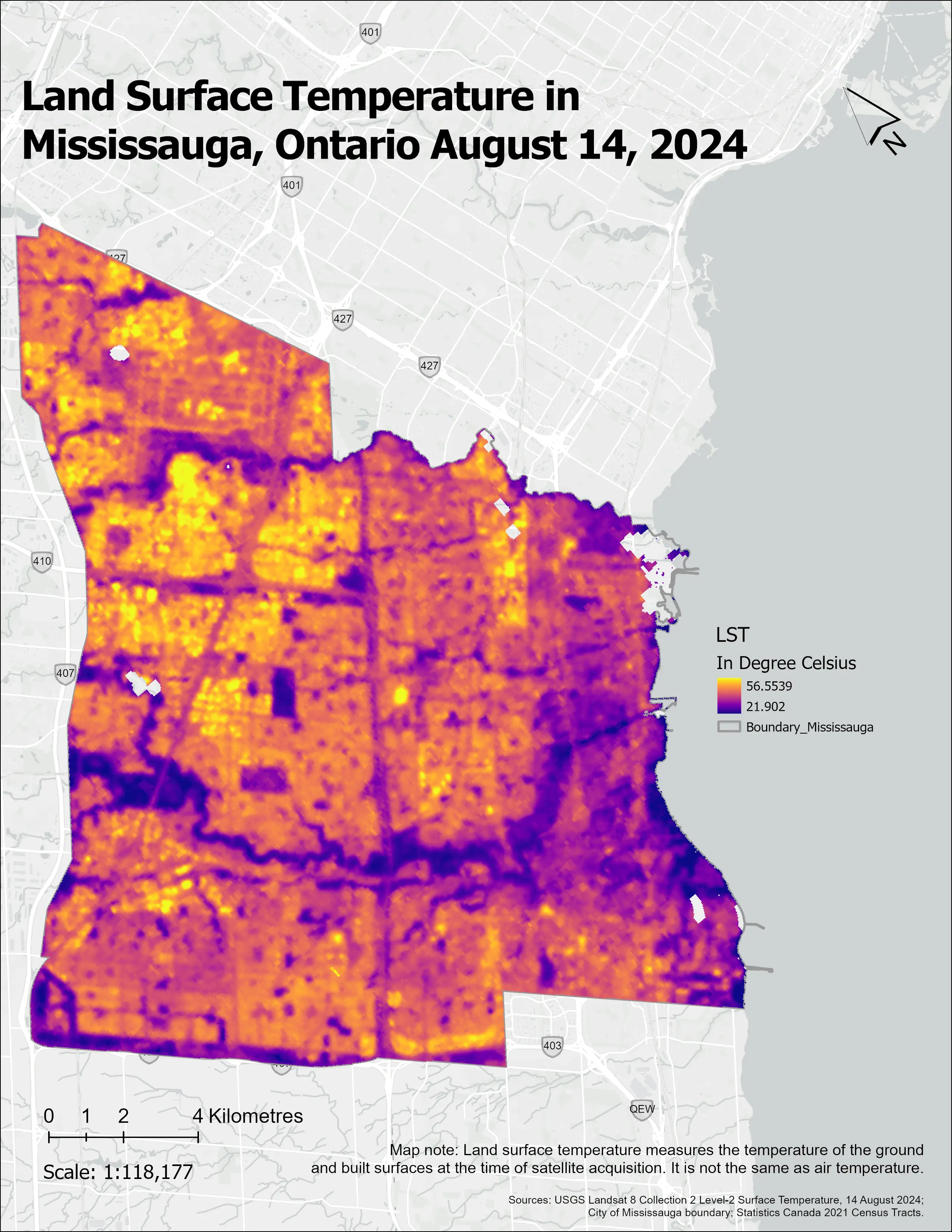
This case study combines land-surface temperature, Census-based social vulnerability, and mapped cooling-resource density to identify tracts where heat-response concerns overlap.
Research question: Where do higher urban heat exposure, greater social vulnerability, and lower cooling-resource density overlap in Mississauga?
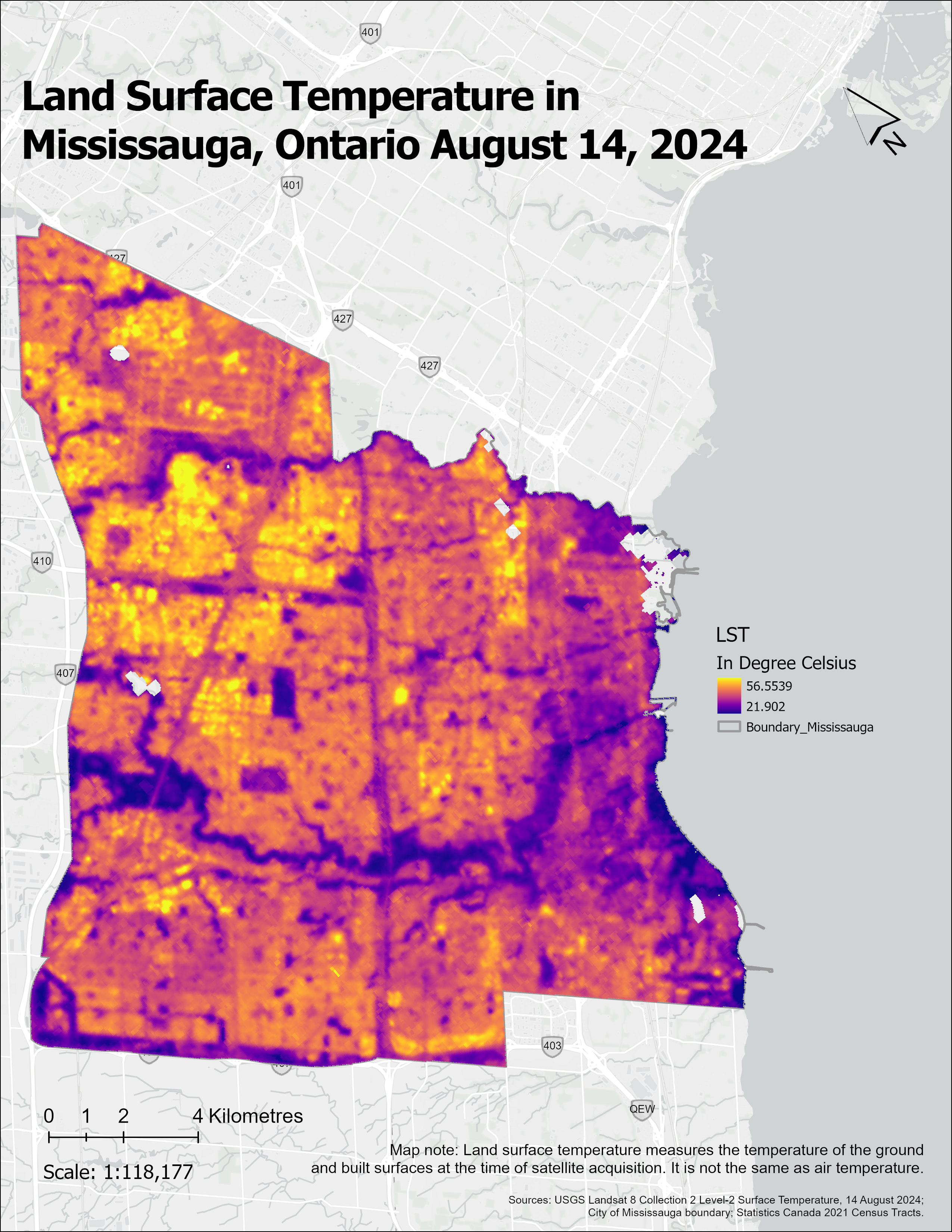
What this shows: This map shows land-surface temperature patterns, not air temperature or predicted heat illness. The full screening result uses this layer as one input to identify where further local assessment may be useful.
The Landsat image represents one acquisition date, land-surface temperature is not air temperature, Census Tract averages smooth local variation, and cooling-resource density does not measure capacity, hours, walking access, transit access, accessibility, shade quality, or service quality.
The next step is to test multiple summer scenes, model walking or transit access, add facility details, review threshold sensitivity, and validate priority areas through local assessment and community consultation.
Washington, D.C. | Food access
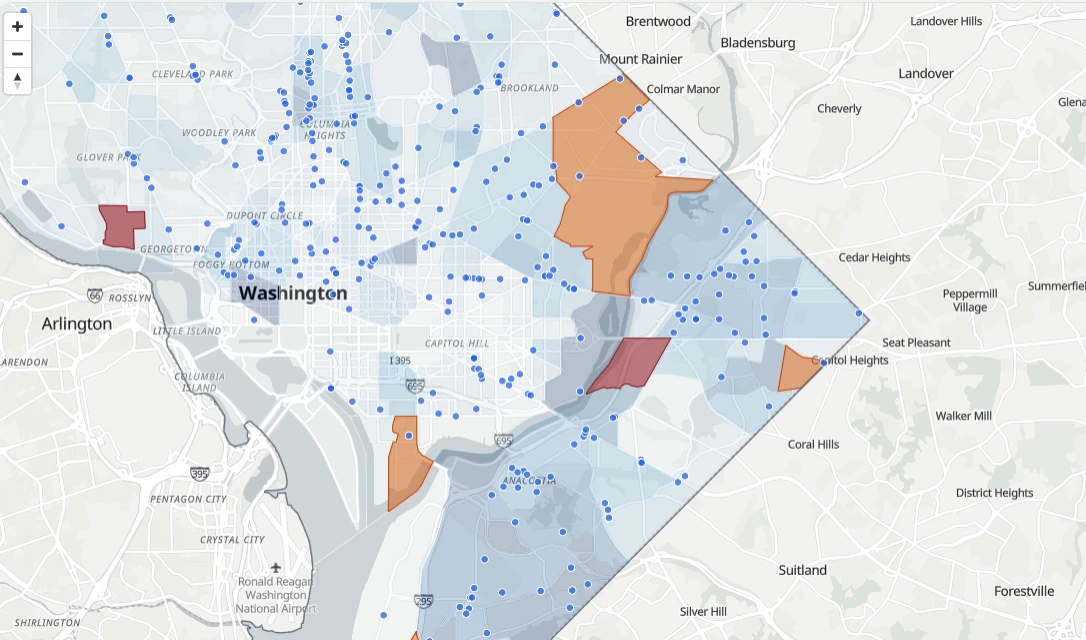
This project compares food assistance infrastructure with economic need in Washington, D.C.
Research question: Where does food assistance access fail to align with economic need in Washington, D.C.?
This map compares food assistance infrastructure with tract-level poverty in Washington, D.C. SNAP retailers and farmers markets show where food access points exist, while the poverty layer shows where economic need is higher. The goal is to examine whether food access aligns with the communities most likely to need it.
How to use this map: Toggle poverty, SNAP retailers, farmers markets, and candidate access gaps to compare food assistance locations against areas of higher economic need.
Interactive map using public food access, SNAP retailer, census tract, and poverty context data.
Map question: Where do food assistance locations overlap with higher-poverty census tracts?
Compare SNAP retailer locations against higher-poverty tracts. Areas with higher poverty and fewer nearby access points should be investigated further.
Limitation: This analysis uses straight-line distance from tract representative points and does not account for transportation, walkability, food price, store quality, or operating hours.
What this shows: Food access gaps matter most when they overlap with economic vulnerability. Higher-poverty areas with fewer nearby SNAP-supported retailers should be treated as candidate areas for deeper review, not as final conclusions.
Decision value: This screening map can help identify areas for SNAP retailer outreach, food access planning, or deeper network-distance analysis.
Prepared food location layers, classified SNAP-supported and non-SNAP locations, exported GeoJSON, and used web mapping to communicate the difference between availability and practical access.
The web map is a screening tool for spatial patterns. The next step is to add measured network distance, transit access, or service-area analysis to better represent practical accessibility.
Future review should also compare food infrastructure against need, not map locations alone.
Windsor, Ontario | Environmental GIS | Urban forestry
This supporting GIS project uses a priority screening workflow to narrow a city-wide urban forestry question into candidate areas for further review.
Research question: Where should Windsor prioritize further review for new tree planting based on heat exposure, low existing tree density, and public/community benefit?
Context / why it matters: Urban trees can reduce heat stress, improve pedestrian comfort, support public health, and strengthen green infrastructure. This GIS suitability workflow helps narrow a city-wide problem into priority areas that can be checked for ownership, field conditions, municipal planting constraints, and community needs.
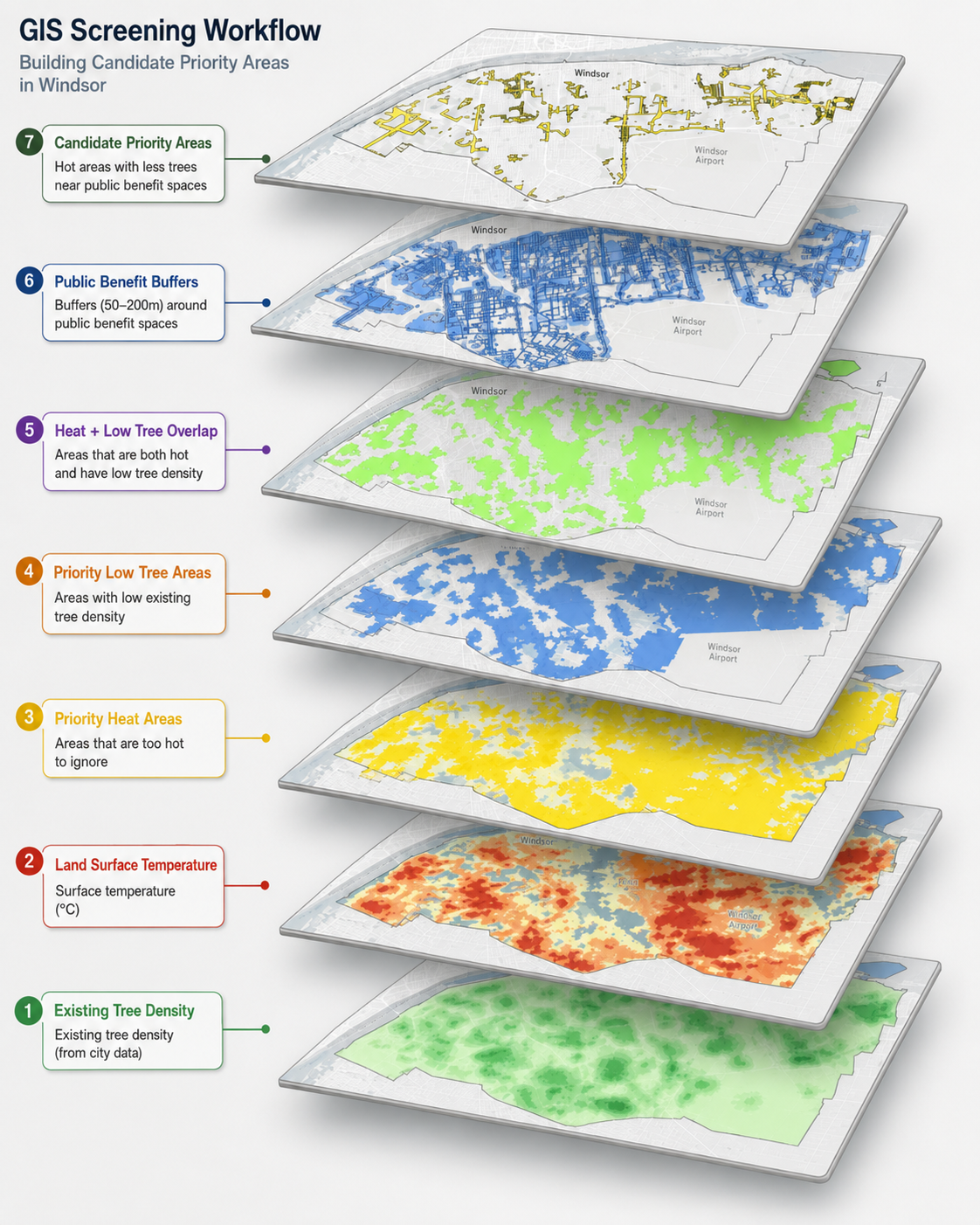
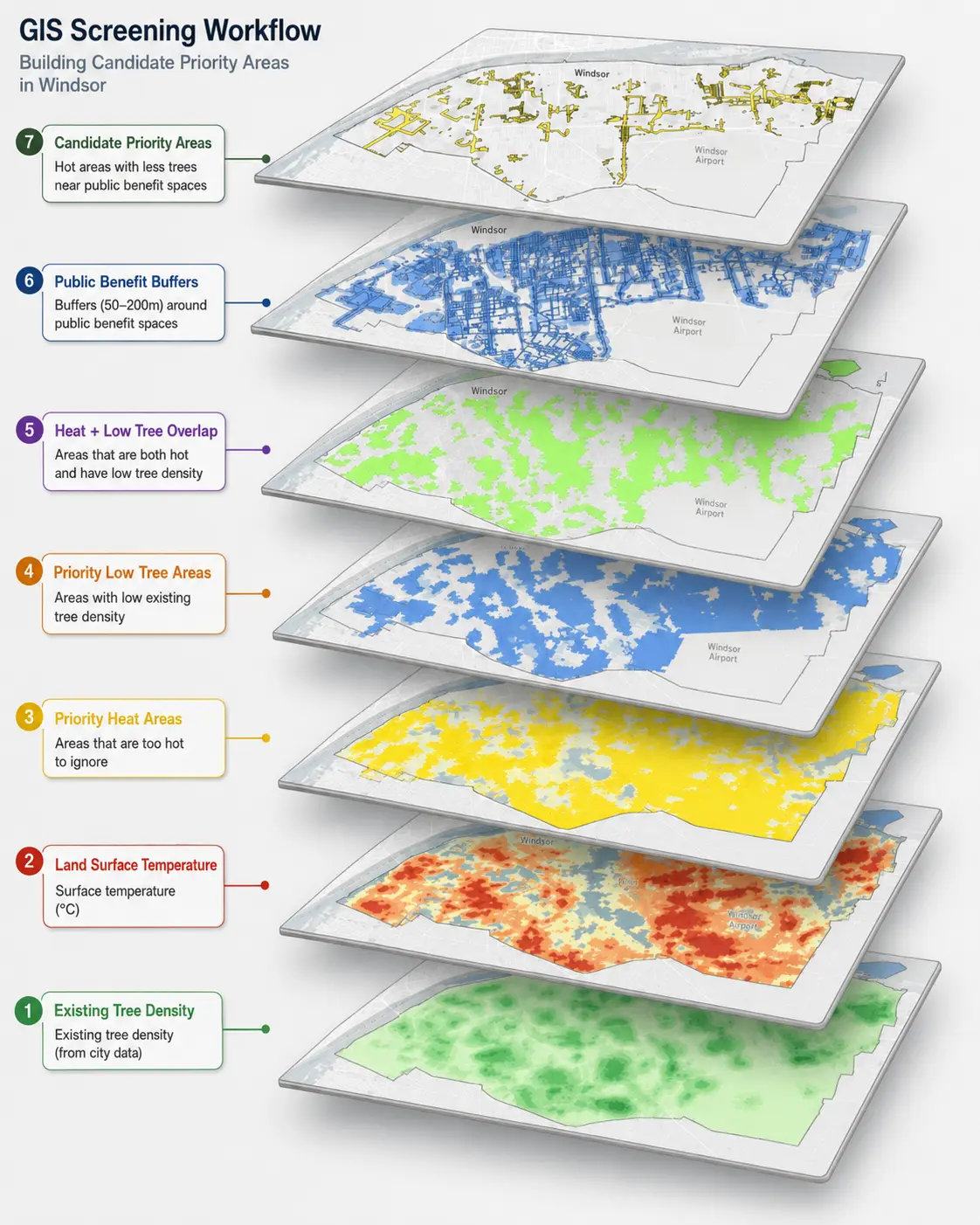
This visual sequence shows how the analysis moves from broad input layers to candidate priority areas. Each step adds one planning filter: heat exposure, existing tree density, public/community benefit, and further review.
Keep scrolling to see how each layer narrows the analysis.
1 / 7
High heat + low tree density + public/community benefit proximity = candidate priority areas for further review.
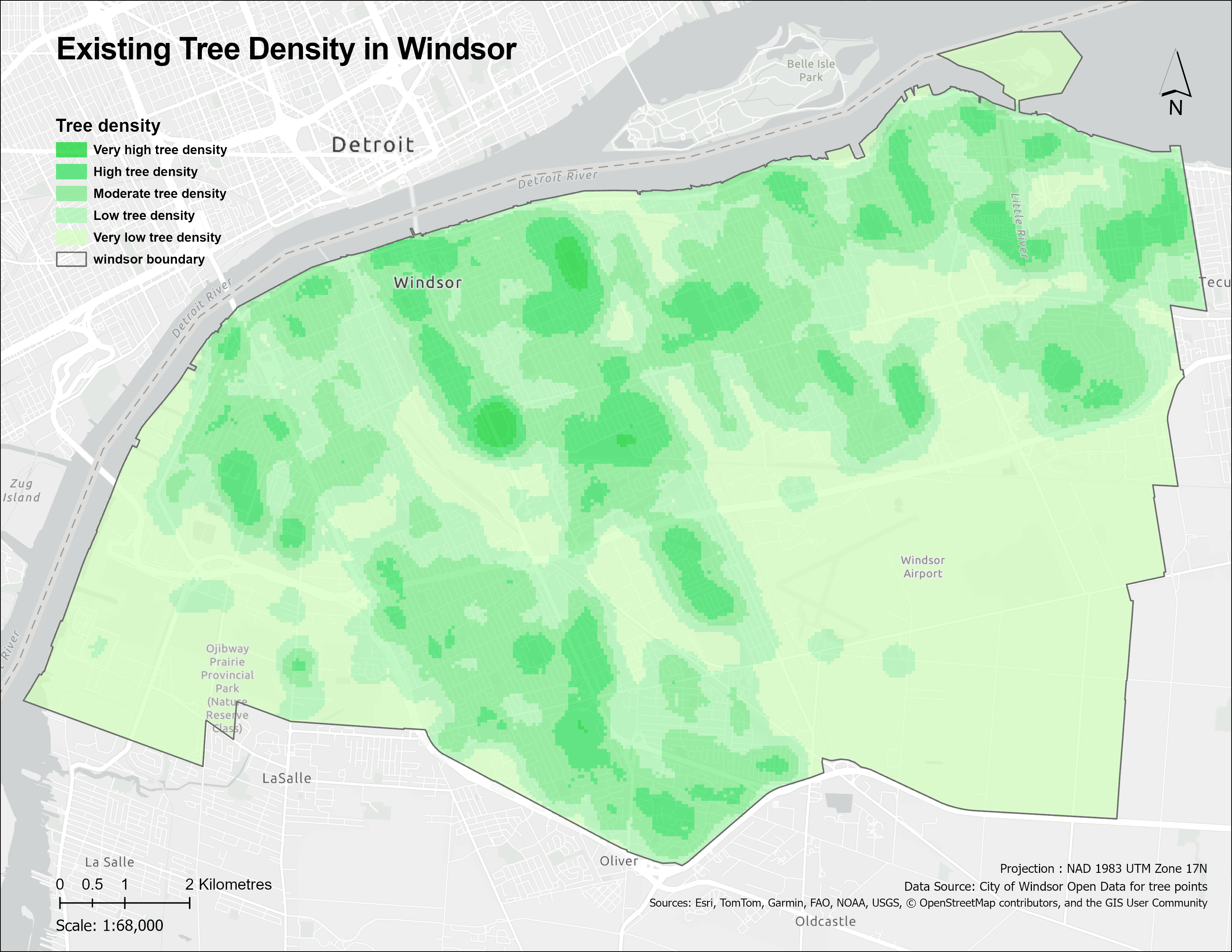
Question: Where are there fewer trees?
Right-of-way and park tree datasets were combined to show areas with lower existing tree density.
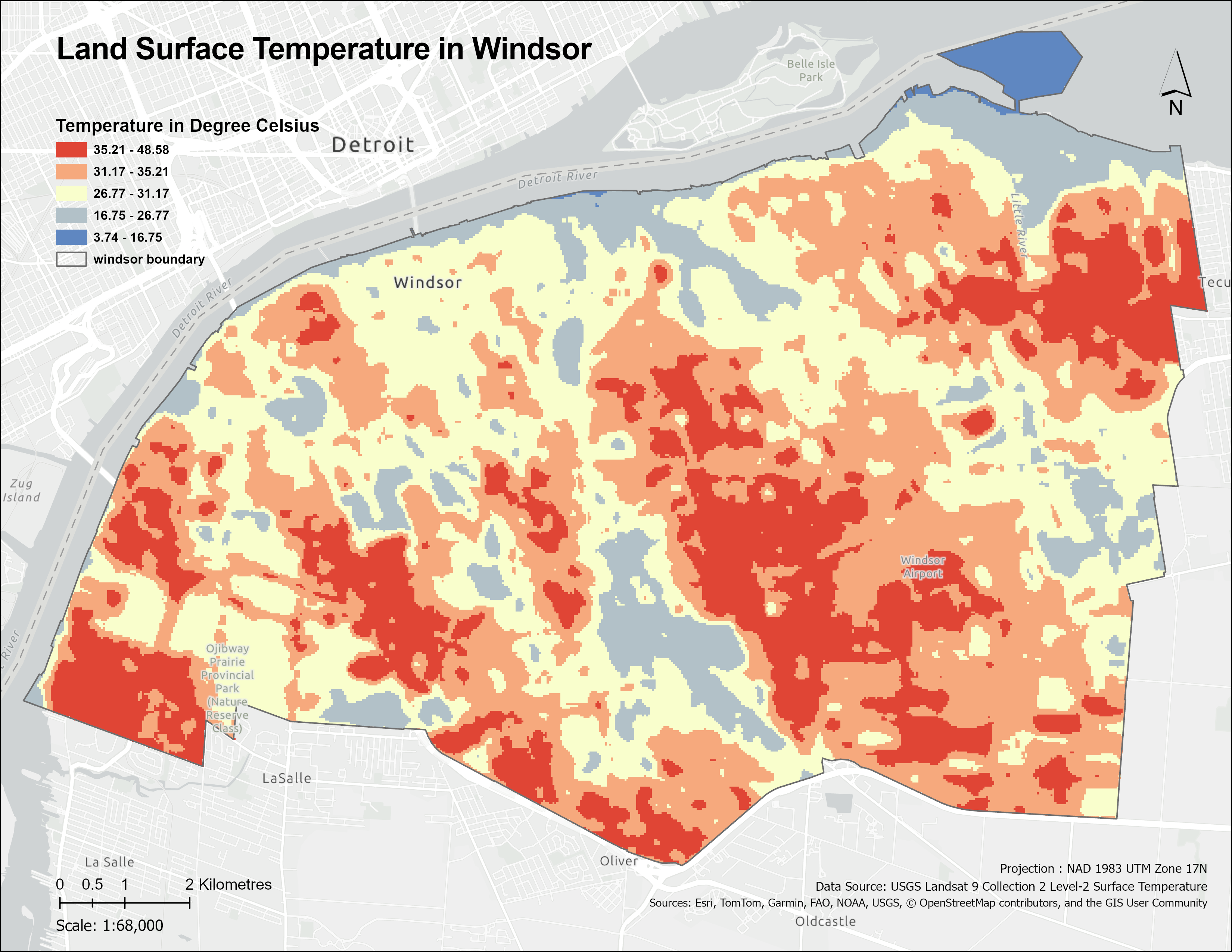
Question: Where is Windsor hotter?
Landsat surface temperature highlights city-scale heat patterns across Windsor.
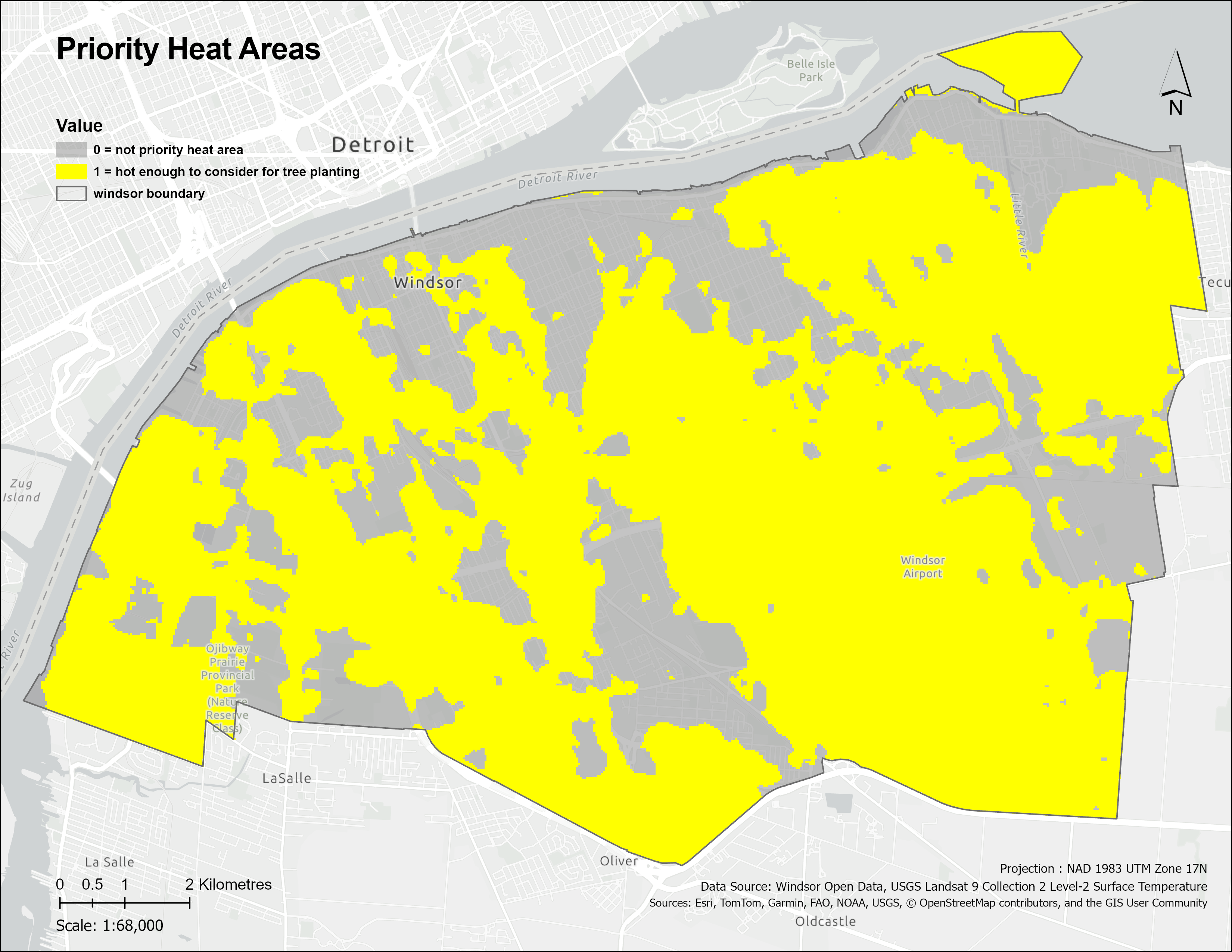
Question: Which areas are hot enough to screen further?
The hottest surface temperature classes were reclassified into a binary heat-priority layer.
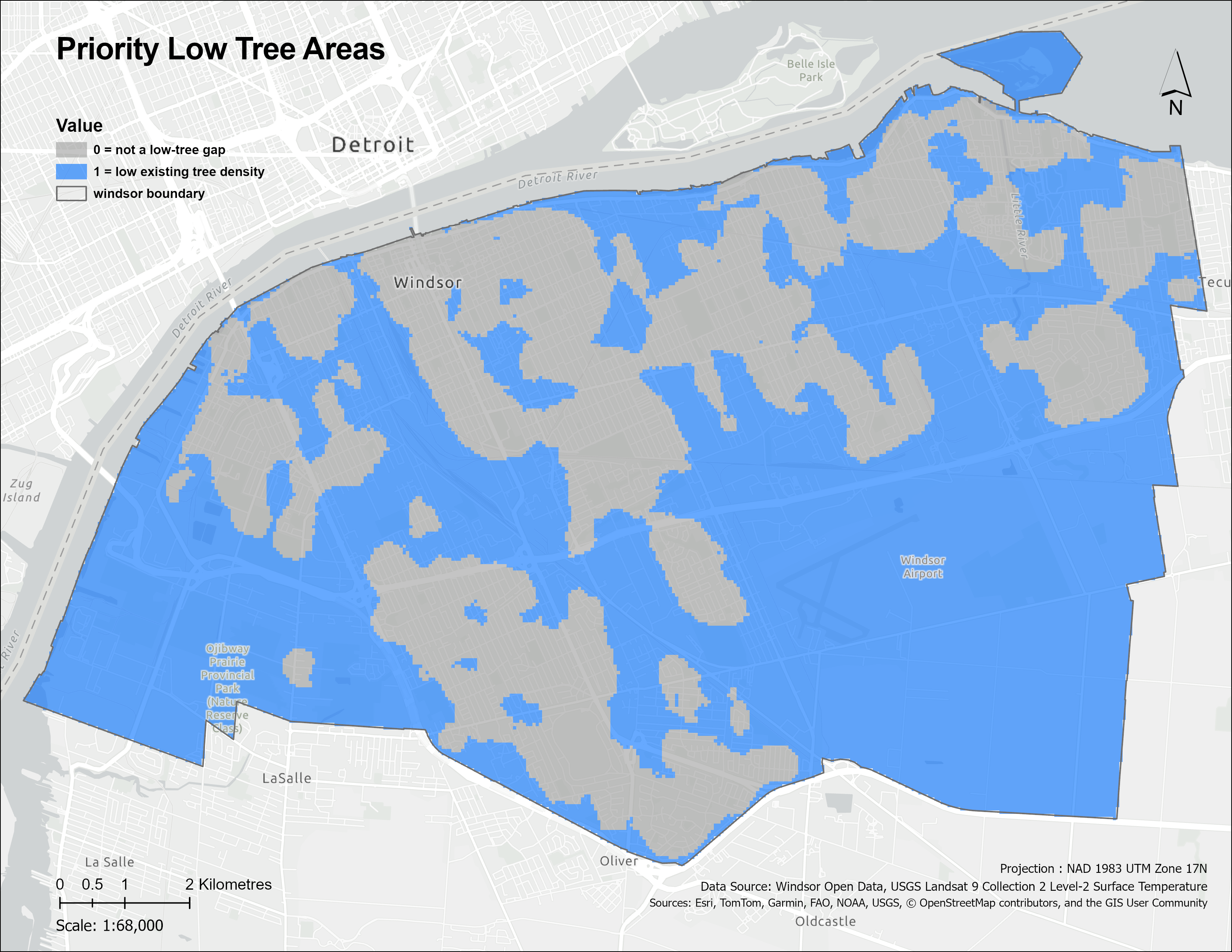
Question: Where does existing tree density suggest canopy need?
Lower tree-density areas were reclassified as priority areas for canopy improvement.
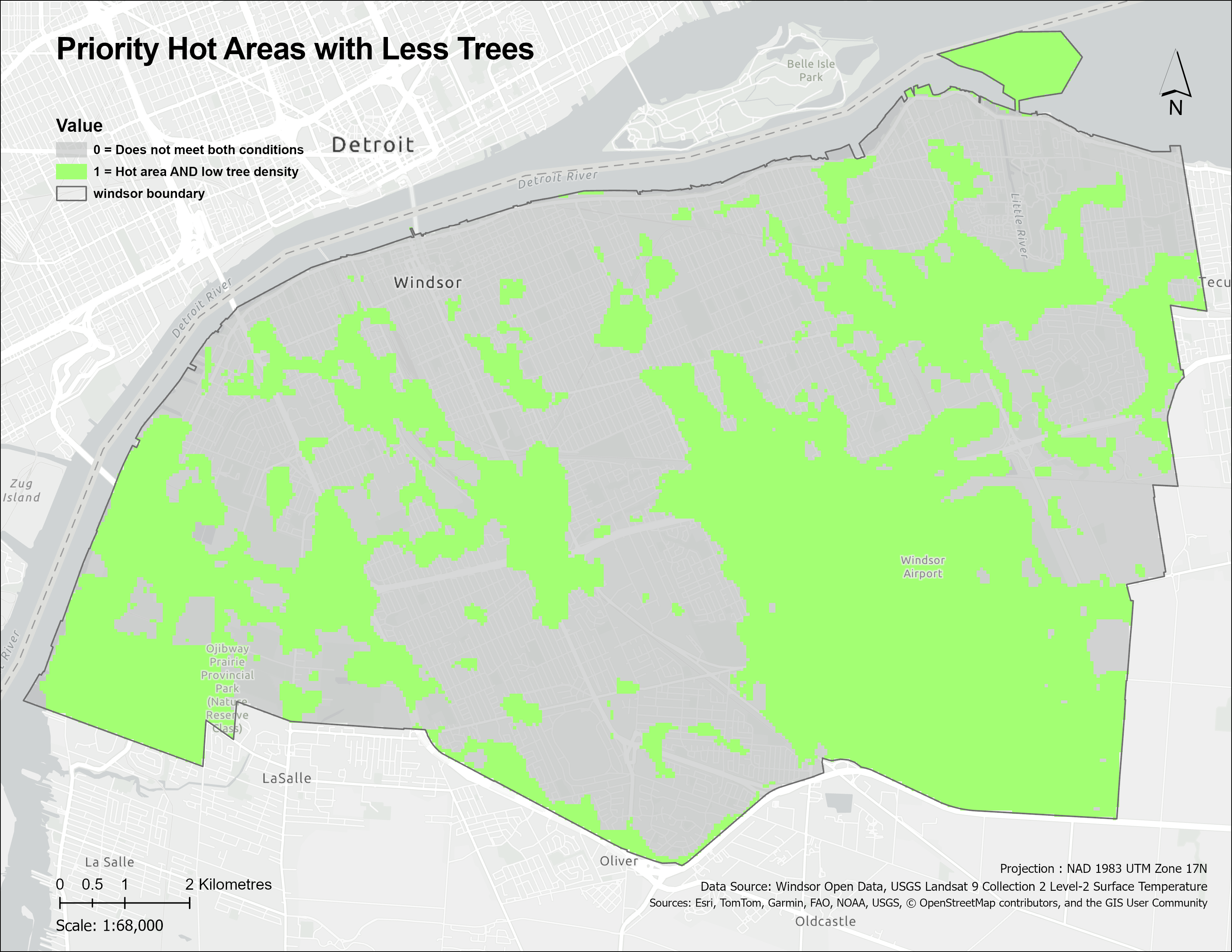
Question: Where do heat and canopy need overlap?
The heat-priority and low-tree-density layers were combined to keep only areas where both conditions were present.
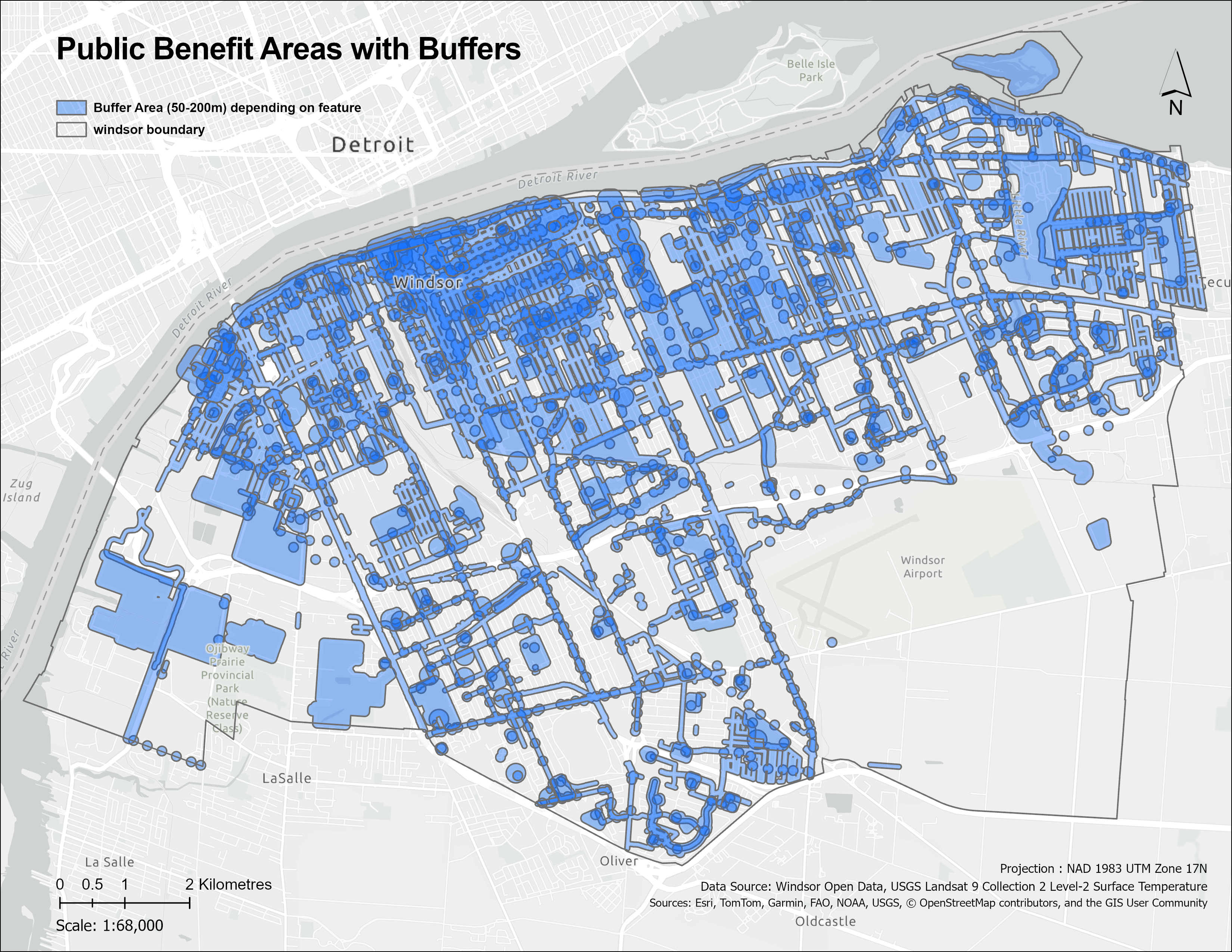
Question: Which priority areas are near public/community features?
Parks, schools, playgrounds, sidewalks, bus stops, and BIAs were buffered to estimate public/community benefit areas.
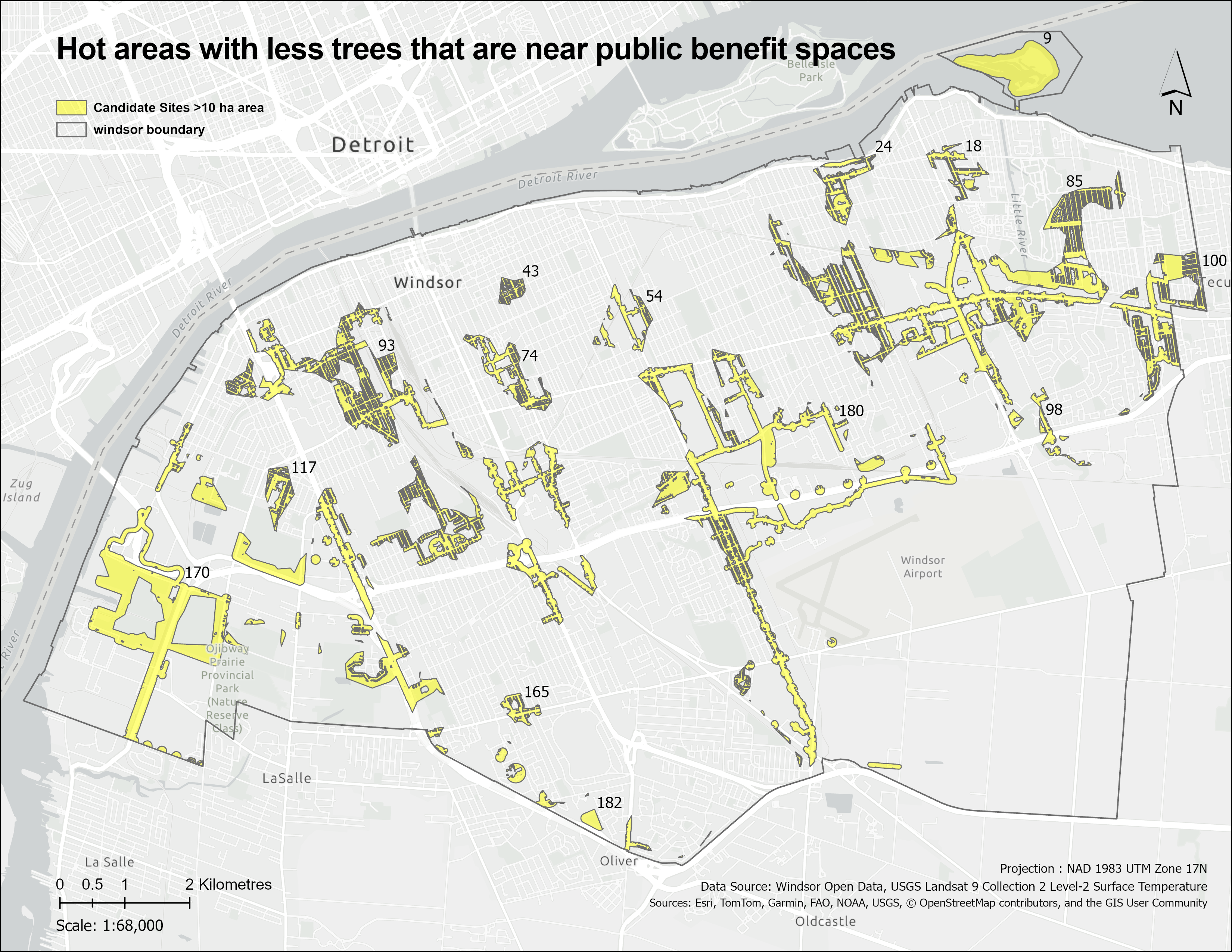
Question: Which areas remain after screening?
Hot, low-tree-density areas near public/community features were identified as candidate priority areas for further review.
On smaller screens, the Windsor workflow is shown as a step-by-step map sequence. Each map adds one planning filter and moves the analysis closer to candidate priority areas for further review.
Scroll through the maps to follow the screening logic.
1 / 7
Step 1 of 7
Question: Where are there fewer trees?
Step 2 of 7
Question: Where is Windsor hotter?
Step 3 of 7
Question: Which areas are hot enough to screen further?
Step 4 of 7
Question: Where does existing tree density suggest canopy need?
Step 5 of 7
Question: Where do heat and canopy need overlap?
Step 6 of 7
Question: Which priority areas are near public/community features?
Step 7 of 7
Question: Which areas remain after screening?
I built a GIS workflow to find areas where high heat, low existing tree density, and nearby public/community features overlap. These areas are candidates for field review, not selected planting locations.
The main output is a planning-level screening result: a smaller set of places where tree-planting feasibility should be reviewed in more detail.
The next step would be parcel ownership review, underground utility checks, field verification, municipal planting constraints, and community consultation before moving from screening results to planting decisions.
United States | Housing | 2020-2024
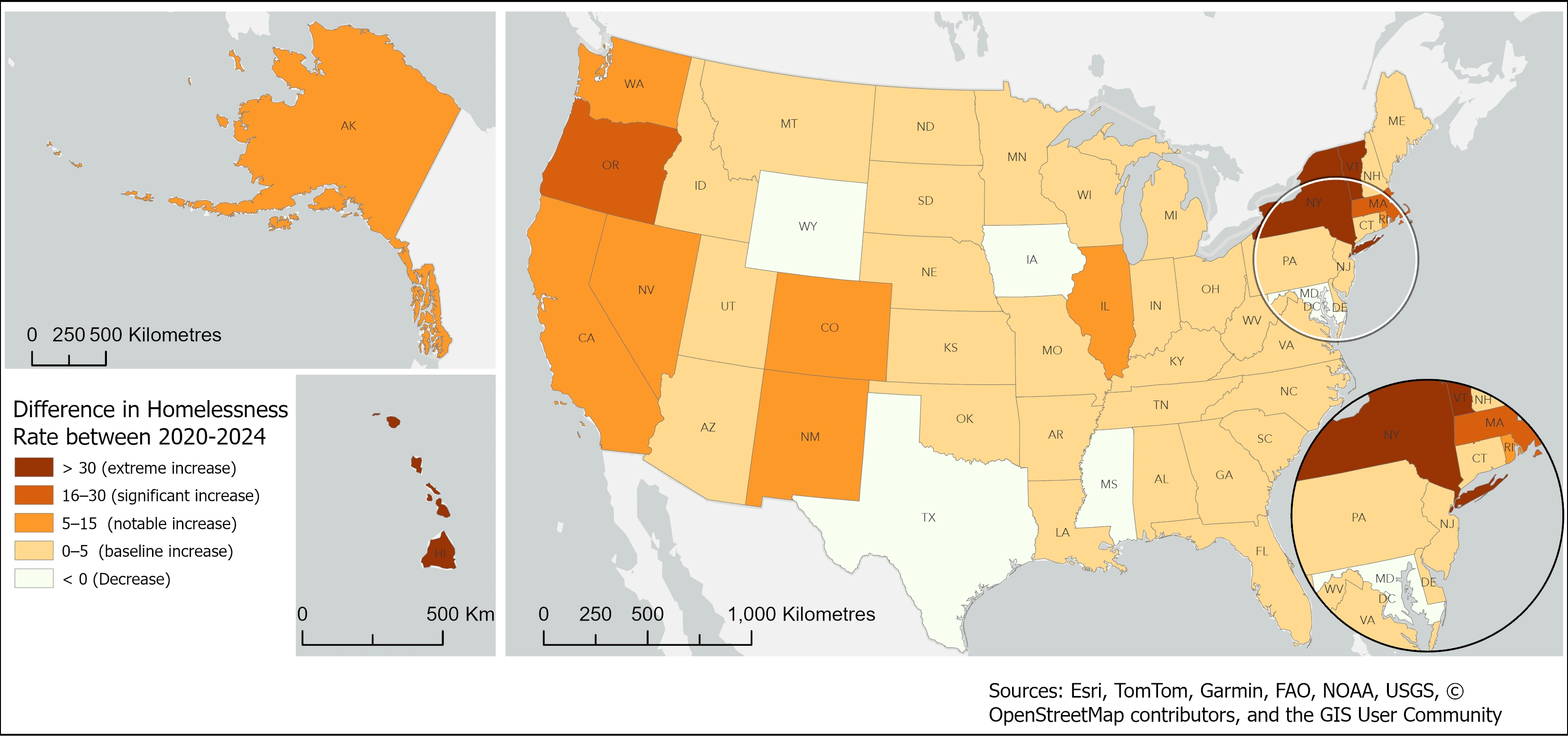
This project compares state-level homelessness through count, rate, change, and unsheltered share.
Research question: How do state-level homelessness patterns change when measured by total burden, population-adjusted rate, rate change, and unsheltered share?
Key insight: The same state can look different depending on whether the question is burden, intensity, change, or shelter condition.
The following maps and charts compare homelessness by total count, population-adjusted rate, rate change, and unsheltered share.
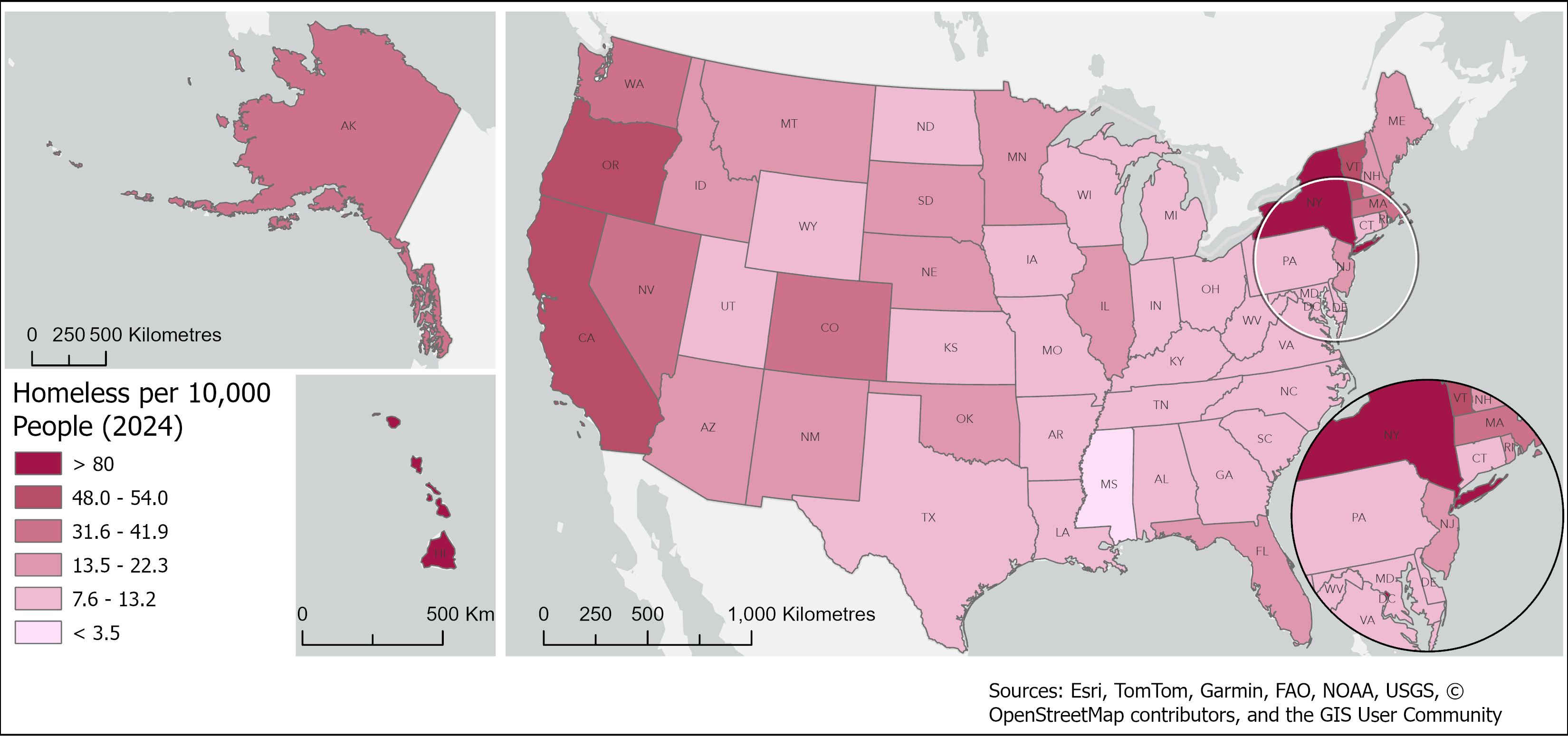
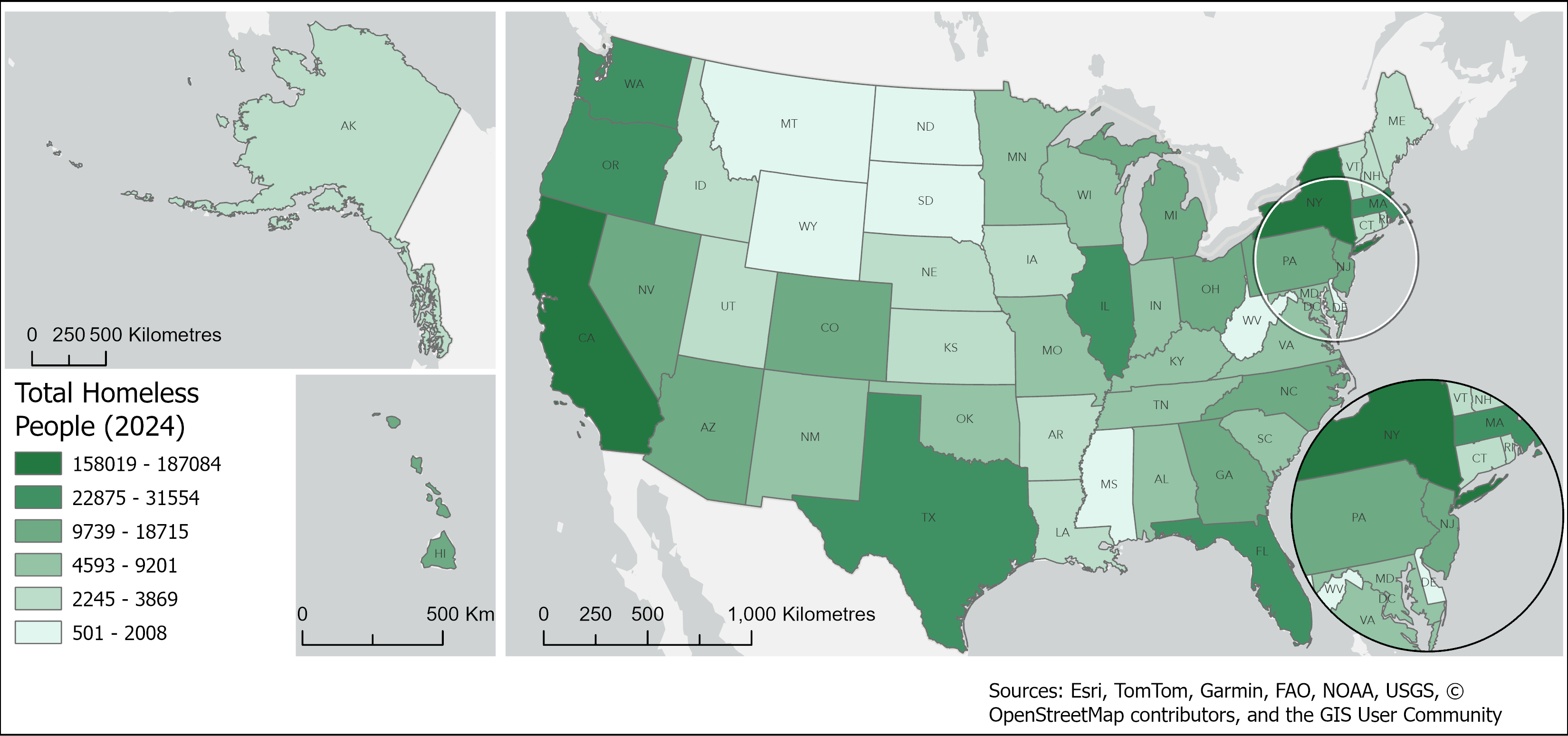
Use the slider to compare two perspectives. Total counts show where the largest number of people are experiencing homelessness, while rates show where homelessness is most intense relative to population.
Change in homelessness rate can be read in two ways. Absolute change shows how much the rate increased or decreased, while standard deviation change shows which states stand out as unusual compared with the national pattern.
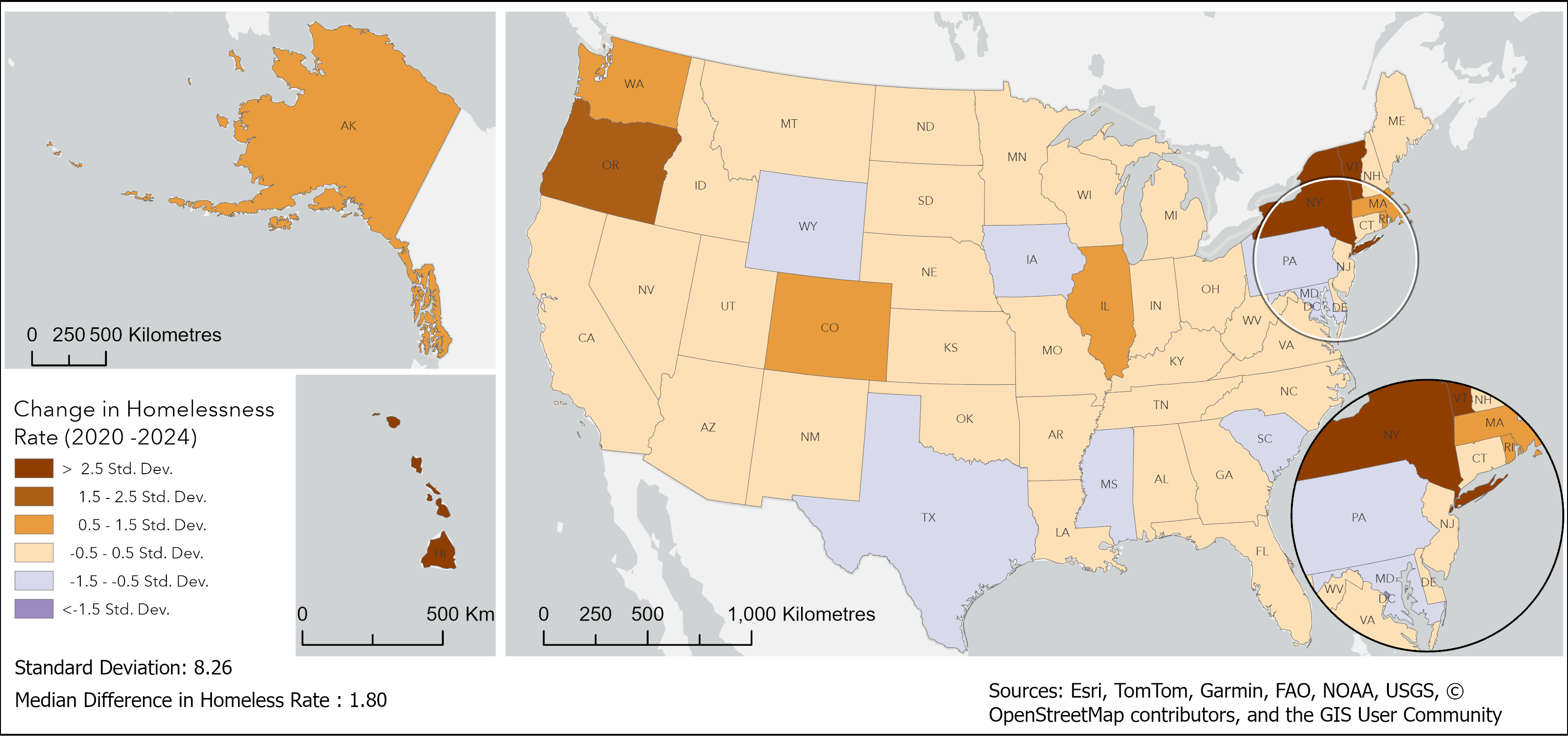
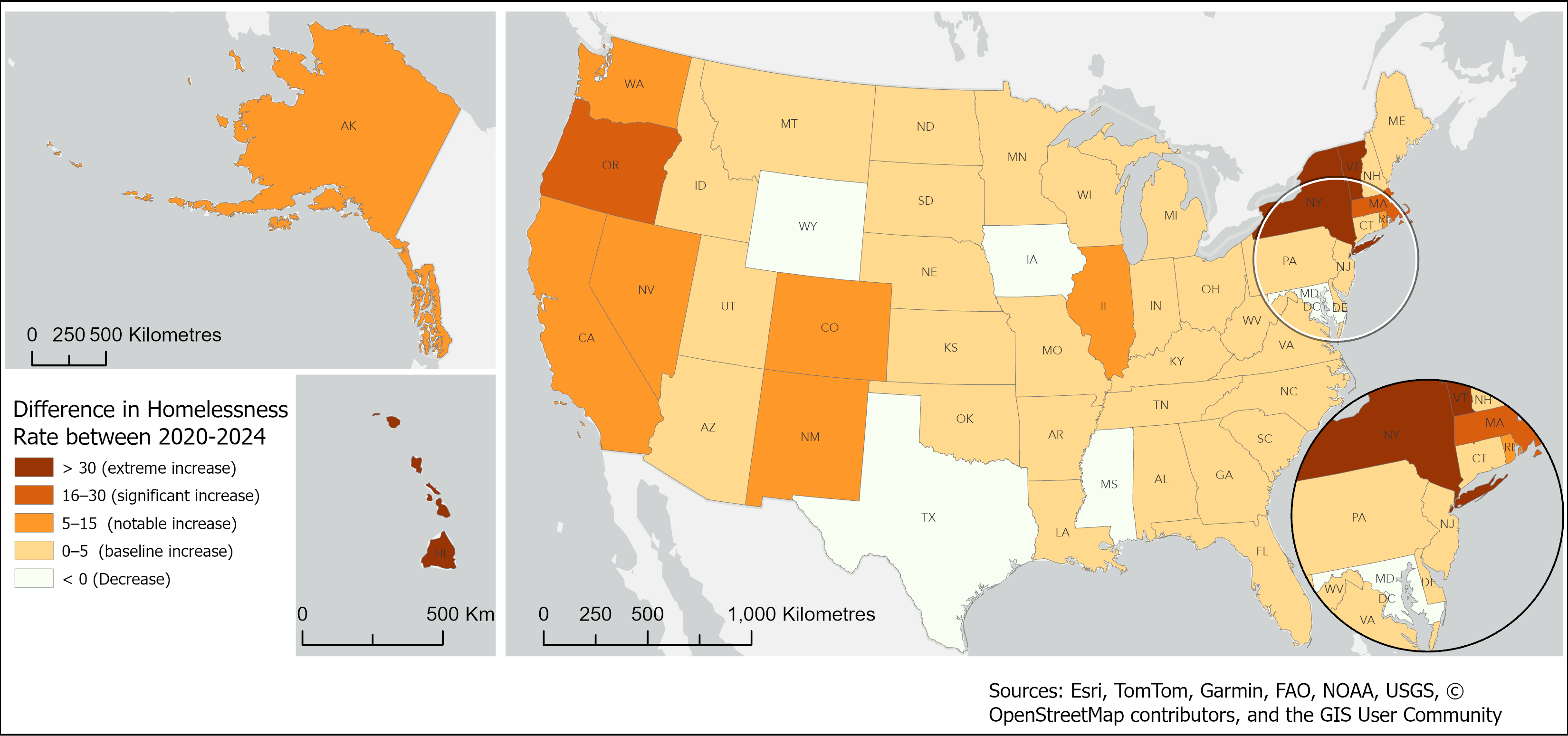
Use the slider to compare two ways of reading change. Absolute change shows where homelessness rates increased or decreased the most, while standard deviation highlights which states stand out compared with the national pattern.
Homelessness is not only a question of scale. States with similar homelessness rates can differ sharply in how homelessness is experienced. The unsheltered share shows where people are more likely to be outside the shelter system, while the bubble chart compares rate, unsheltered share, and total count together.
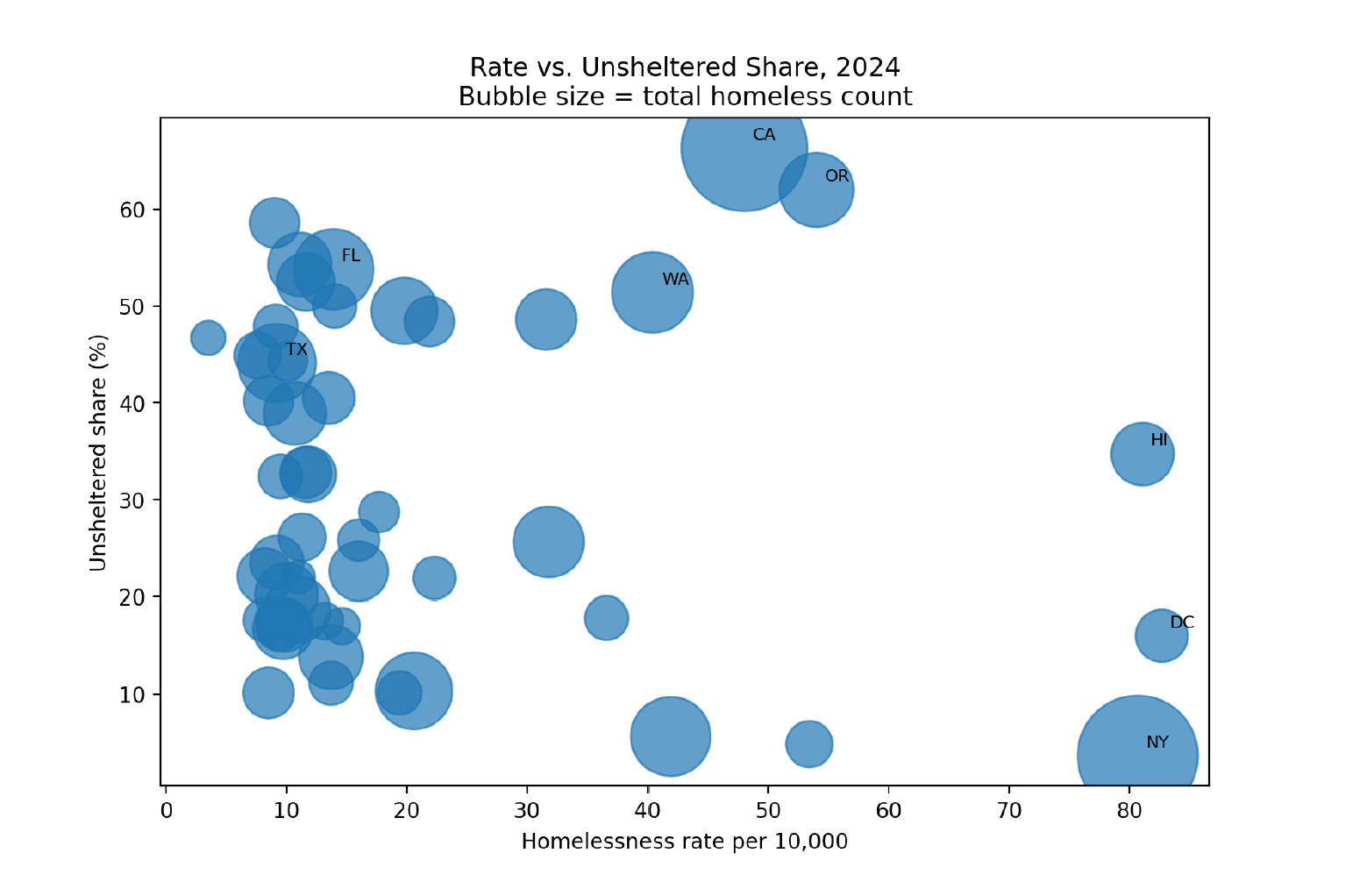
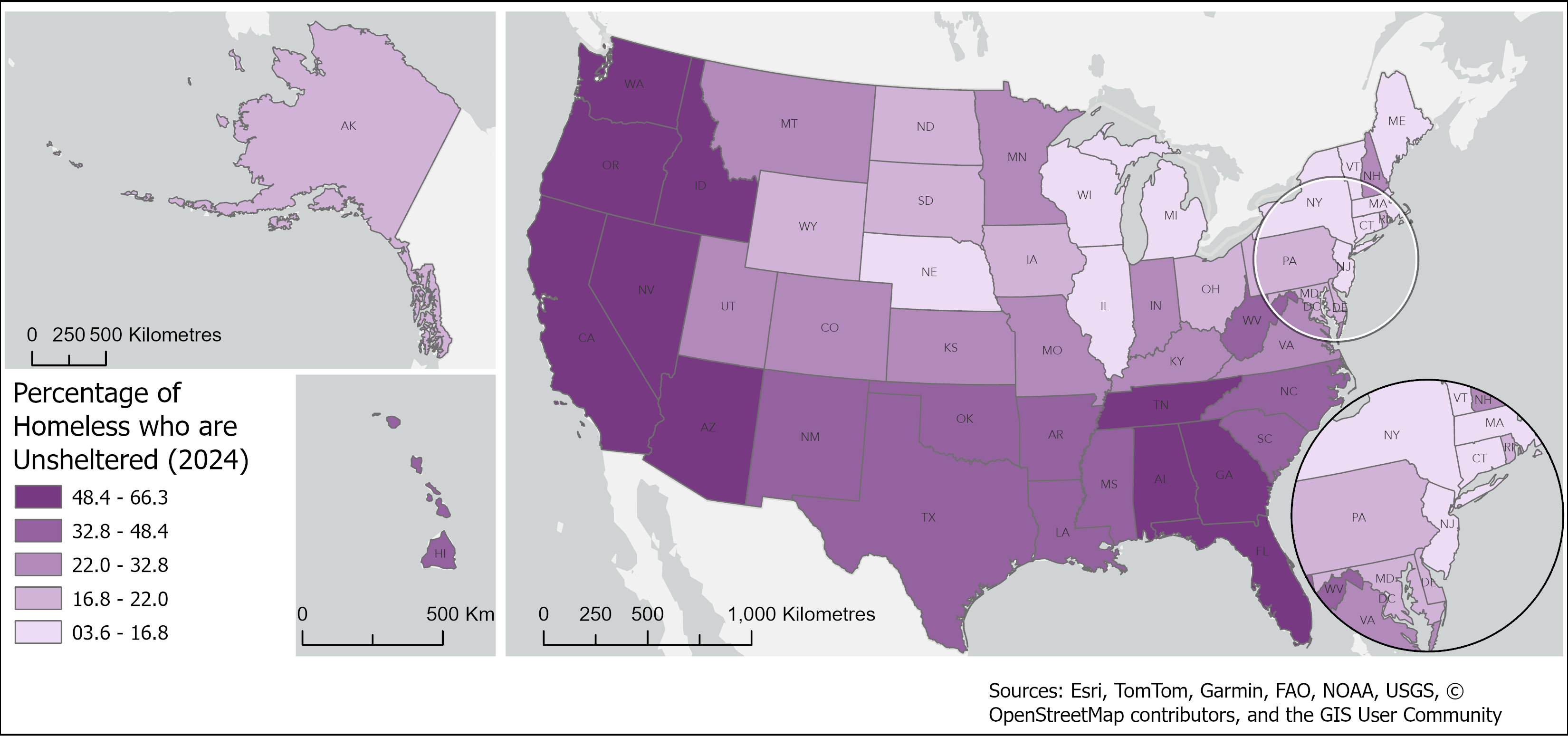
Decision value: This comparison helps separate where homelessness is largest, where it is most intense, where it is accelerating, and where shelter conditions change the policy response.
Compiled state totals, calculated rates, compared 2020 and 2024 values, and prepared static maps and charts for rate, count-versus-rate, change, and unsheltered percentage.
Point-in-time counts are sensitive to local methods, timing, and definitions. Interpretation should account for differences in enumeration practices and local shelter systems.
The next step is to connect these state-level patterns to local housing supply, shelter capacity, and service-system context.
United States counties | Public health
This map compares county-level Black-to-White breast cancer mortality ratios where data for both groups are available.
Research question: Where can Black-to-White breast cancer mortality differences be directly compared at the county level, and what do those comparable counties reveal?
Map interpretation: A mortality ratio greater than 1 means Black mortality is higher than White mortality in that county. The ratio map only includes counties where both Black and White non-Hispanic rates are available.
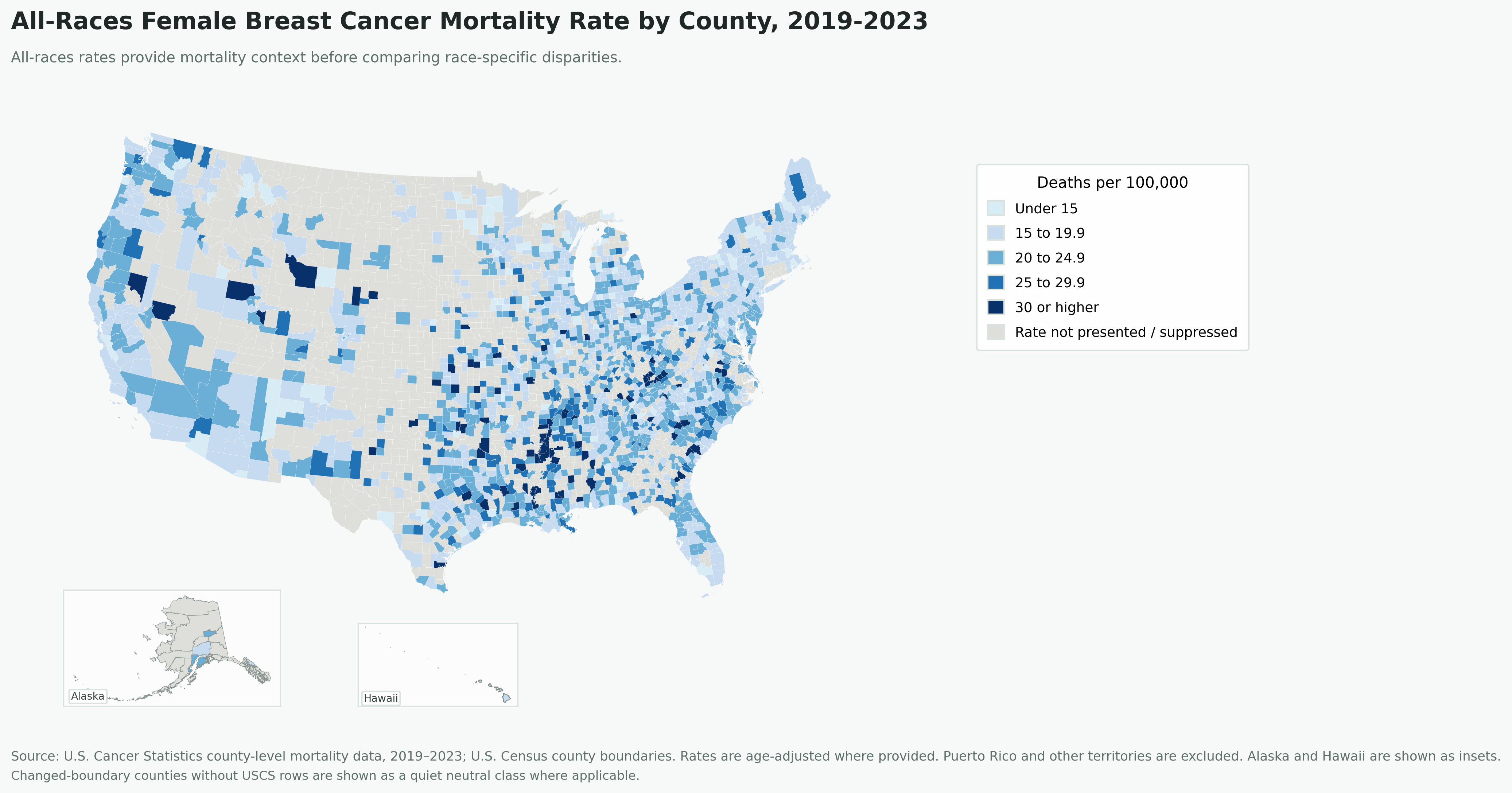
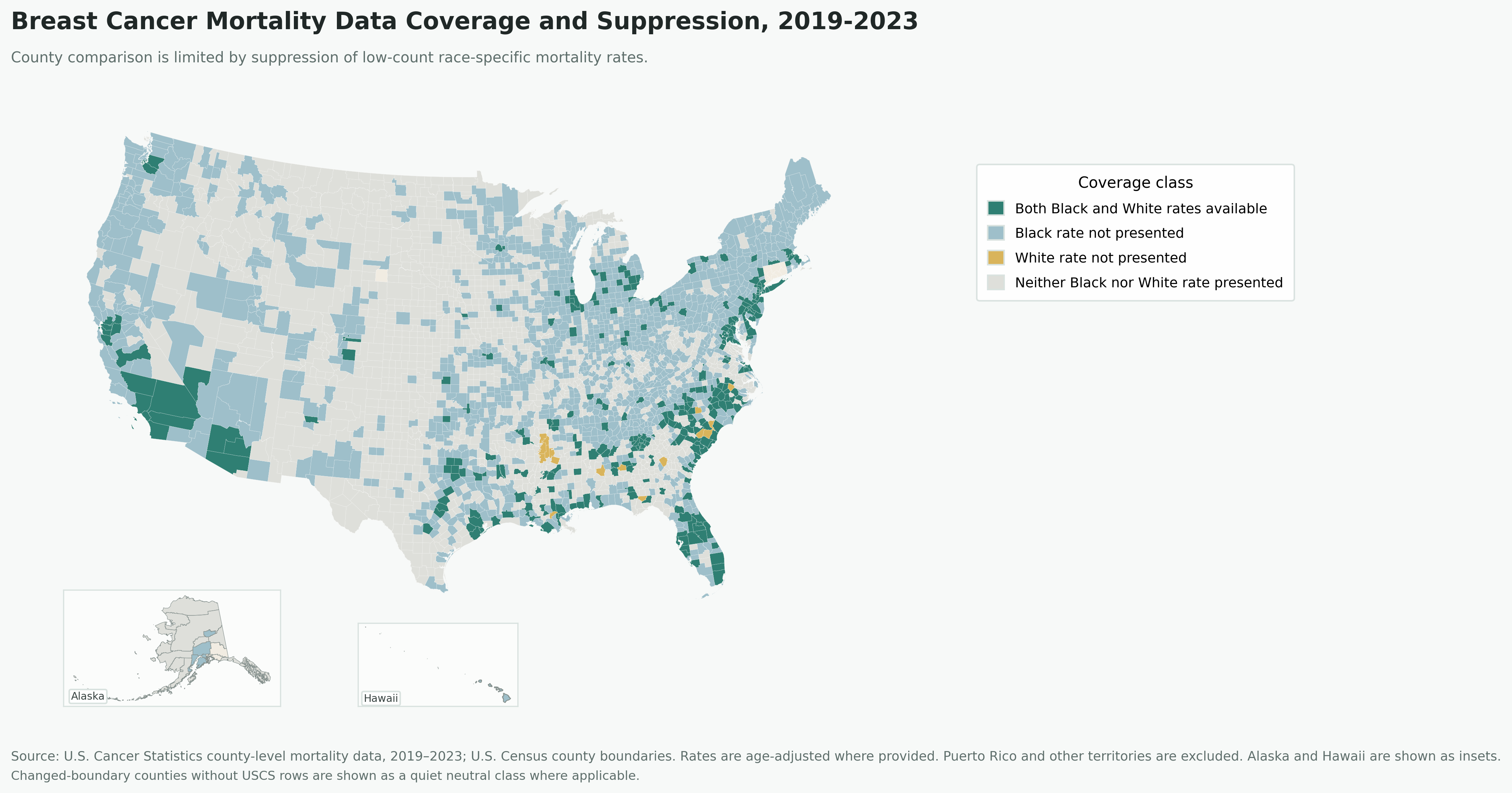
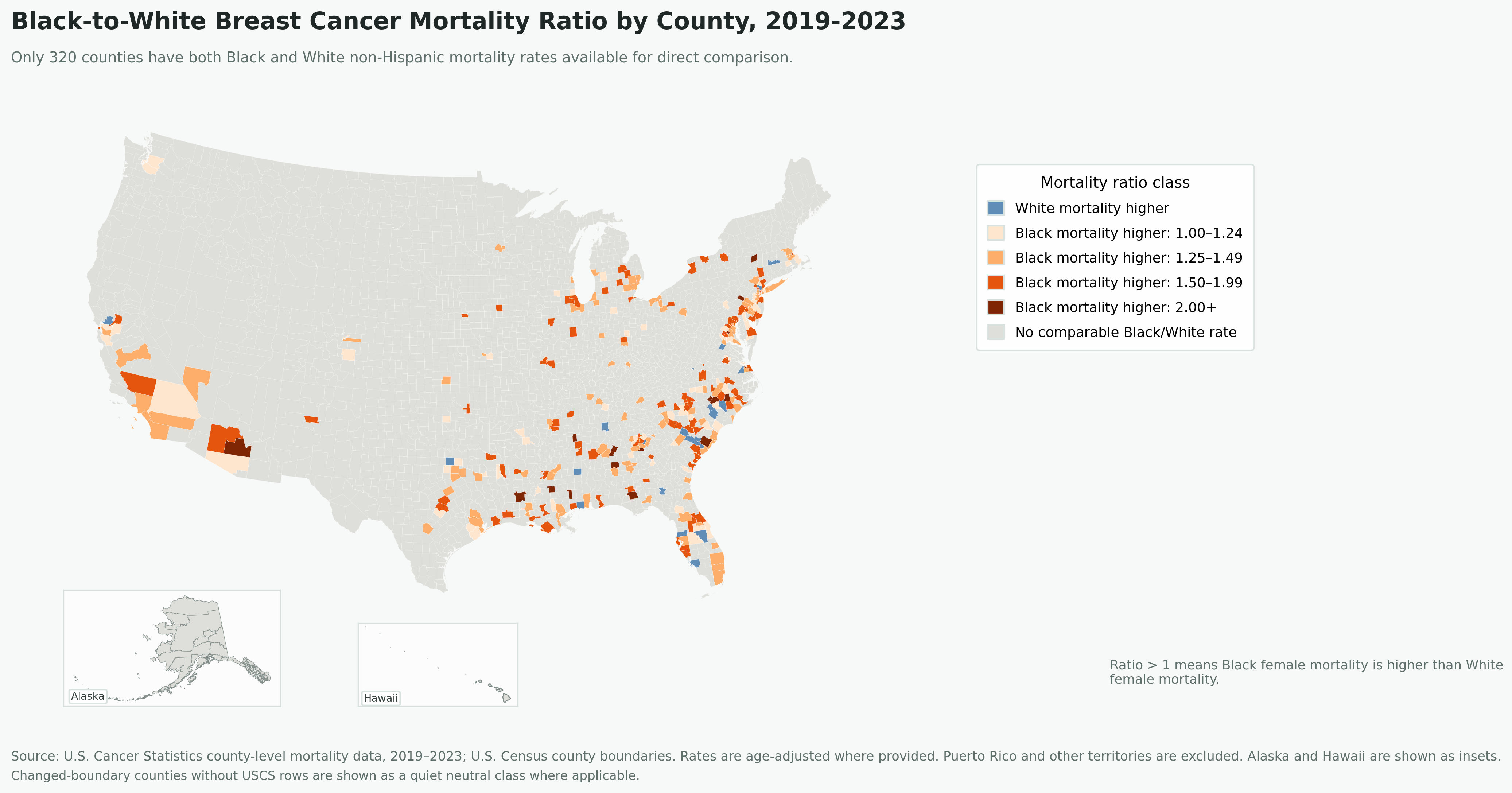
Decision value: This analysis helps identify where county-level mortality disparities are visible enough for follow-up spatial review.
Filtered to comparable counties, calculated Black-to-White mortality ratios, mapped geographic variation, and reviewed where race-specific suppression prevented direct comparison.
Suppressed values and county-level aggregation limit what the maps can show. They should be read as county-level screening maps, not evidence of individual risk or causes.
The next step is to run and document the spatial clustering workflow after the comparable-county dataset is finalized.